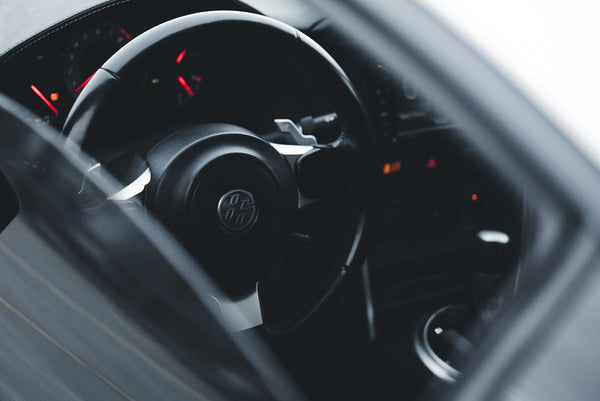
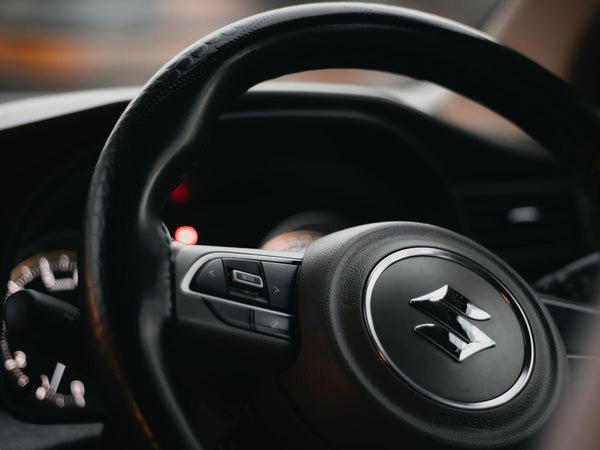
Stitching refers to the visible seams that join the material around the rim. It covers little surface, and yet it shapes the steering wheel. The same black Alcantara rim takes on a completely different character depending on whether its stitching is black, grey or red. Here is how to choose its colour methodically.
Tone on tone or contrasting: which look should you aim for?
There are two approaches, and each has its own effect.
- Tone on tone: the stitching picks up the colour of the material. The steering wheel looks like a single block, understated and uniform. It is the most discreet choice.
- Contrasting: the stitching stands out against the material. It underlines the outline of the rim and the joins between zones. The steering wheel gains a sportier character.
Between the two, a close but slightly lighter colour, grey on black for example, adds relief without drawing the eye.
| Desired effect | Stitching | Result |
|---|---|---|
| Understated | tone on tone | Uniform steering wheel, discreet lines |
| Subtle relief | close, lighter shade | Seams visible up close |
| Sporty | contrasting colour | Outline of the rim underlined |
| Signature | colour taken from the cabin | Steering wheel tied to the rest of the interior |
How do you match the stitching to the material?
The material changes how the seam is perceived. On Alcantara, whose surface is matte and velvety, a contrasting seam stands out clearly. On smooth nappa leather, it reads with more finesse. On perforated leather, the texture of the surface already complements the seam and often calls for a more restrained colour.
If your steering wheel combines several materials, the stitching links them. A single stitching colour across the whole steering wheel gives a mixed-material wheel a unified look. The guide on dividing materials between zones helps you lay that foundation first.
How do you pick up a colour from the cabin?
The most reliable method starts from what is already in the car. Look at:
- the stitching of the seats and door panels;
- the colour of the seat belts;
- the badges and logos of the sport model line;
- the dashboard or console inserts;
- the shade of the brake calipers or the body paint, visible from the driver's seat.
A colour taken from the cabin ties the steering wheel to the rest of the interior. The steering wheel then looks designed for the car from the start. Take a photo of the interior in daylight before configuring: it serves as a reference for comparing shades.
How do you coordinate stitching, 12 o'clock marker and airbag cover?
The stitching works with two other details of the configurator. The 12 o'clock marker marks the top of the rim and is chosen from several colours. The airbag cover, offered in nappa leather or Alcantara, also gets its own colour, stitching and logo, all of your choosing.
Three combinations work well:
- A single accent colour for the stitching and the 12 o'clock marker: the cleanest read.
- Tone-on-tone stitching and a coloured 12 o'clock marker: a single accent, placed where the eye lands.
- Contrasting stitching repeated on the airbag cover: the centre of the steering wheel extends the rim.
The Materials page presents the ten zones of the configurator, from the base to the badges, with the options for each.
Our advice for your project
For an everyday steering wheel in a restrained interior, tone-on-tone stitching or a close shade keeps the whole elegant. For a sport-model car, a colour taken from the badges or the seat stitching gives a steering wheel consistent with the identity of the model. For a bold project, a contrasting colour matched to the 12 o'clock marker makes the steering wheel the centrepiece of the cabin.
The colour of the stitching completes the choice of material. To decide on that, read the guide to choosing your steering wheel material, then build your custom steering wheel zone by zone.
If you are torn between visible stitching on smooth or on perforated leather, the article smooth or perforated leather compares the two surfaces.