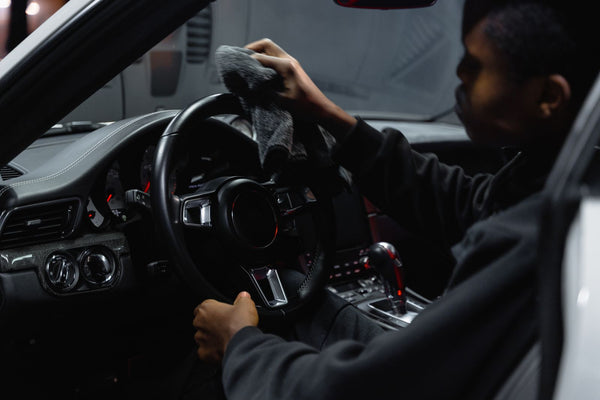
Choosing between leather and carbon is not about picking a winner. On a steering wheel, the areas you hold most and the areas you look at do not play the same role. Leather works well on the sides of the rim. Carbon gives a strong visual presence on the top or bottom. A configuration can use one, the other, or combine them with a clear split.
What difference can you see and feel at the wheel?
| Criterion | Leather | Carbon |
|---|---|---|
| Contact with hands | Soft, familiar, and continuous surface | Smooth surface on carbon-covered areas |
| Effect in the cabin | Discreet or contrasting depending on the color and stitching | Visible pattern, with a more pronounced sporty appearance |
| Typical placement | Sides and grip areas | Top, bottom, or inserts |
| Pairing | Can be combined with Alcantara or carbon | Can highlight a leather base |
The table describes a way of composing the wheel, not a technical requirement. Someone who wants an understated steering wheel can choose leather for the entire rim. Someone else will prefer a contrast between the parts held in the hands and the parts visible when the steering wheel is straight. Our steering wheel materials guide puts these options in the context of all the available finishes.
Before looking at a reference photo, imagine your steering wheel in your own car. The light, the color of the seats, and the dashboard inserts change how a finish is perceived. A carbon surface that seems subtle in close-up can become the dominant detail in a dark interior. Leather, on the other hand, can fade into the background or create a contrast depending on its shade and stitching.
When should you choose leather?
Leather suits you if you want a feel close to that of a factory steering wheel, with the freedom to choose the color, stitching, and shape of the rim. It integrates easily into an interior whose seats, dashboard or door panels are already upholstered. Black leather with tone-on-tone stitching gives a discreet look. Contrasting stitching makes the detail more visible without changing the main material.
Your habits also play a part in the decision. If you often place your hands on the sides of the steering wheel, define those areas first. The rest can follow the same material or introduce a different look. The guide on material distribution shows how to think in terms of zones rather than the entire steering wheel.
For a result consistent with the car, look at the textures already in the interior. Smooth leather echoes a continuous, understated surface. Perforated leather adds a visible pattern on the rim. The stitching can echo a seat color or stay close to the leather color. These choices create a personal steering wheel without adding another material.
When should you choose carbon?
Carbon catches the eye with its pattern and finish. Placed on the top and bottom, it frames the grip areas and makes the outline of the rim stand out more in the cabin. The color of the stitching and the 12 o'clock marker can carry this contrast further. However, the overall look must stay consistent with the inserts and other materials already visible in the car.
Apex Studio offers two finishes: woven carbon, with a regular pattern, and forged carbon, with a freer design. In this configuration choice, the difference is mainly visual. The comparison woven or forged carbon helps you decide between these two looks without mixing this topic up with the choice between leather and carbon.
Carbon is also judged by how much surface it covers. A small area on the top highlights the upper part of the rim. An upper zone and a lower zone create a more pronounced balance. If the car already has carbon inserts, a photo of the entire interior helps to choose a pattern that works with them. The desired effect is easier to determine in the context of the car than on an isolated sample.
How do you combine leather and carbon without overloading the steering wheel?
A simple starting point is to keep leather on the sides, then place carbon on the top and bottom. Your hands get the same feel in the usual grip positions, while the carbon highlights the outline. You can reverse the proportions if your project places more emphasis on the pattern. The configurator lets you see the areas before choosing the stitching and other details.
To keep the design clear, decide on the main material first. Then choose a single contrast logic: stitching color, 12 o'clock marker, or inserts. Finishes blend more naturally when they repeat a color already present in the interior. Our article on mixing materials on a steering wheel provides other composition examples.
You can prepare two versions of your idea before deciding. In the first, leather dominates and carbon stays an accent. In the second, carbon covers more surface and leather keeps the contact on the sides. Compare the two views at the same size and from the same angle. You will see more clearly whether the steering wheel blends into the interior or becomes the first thing that catches the eye.
Next, look at the steering wheel from two angles: from the driver's seat and from the door opening. From the seat, the upper areas remain close to the line of sight. From the outside, the full shape and material contrasts stand out more. A configuration that looks good in a frontal image may look different in the actual cabin. Also take a photo of the current dashboard to keep its dominant colors in mind.
Finally, keep the choice of materials separate from the choice of equipment. Leather or carbon is a question of rim finish. The buttons, shift paddles and airbag module are a matter of the steering wheel's compatibility with the car. Prepare this information before ordering: you can then focus on the feel and appearance without mixing two very different decisions.
Which choice suits your project?
For a car used every day and a look close to the original, start with leather on the grip areas. For a sporty interior whose lines you want to emphasize, add carbon on the top or bottom. If you already like your car's carbon inserts, carry their spirit into the rim, making sure that the chosen pattern matches them.
The choice also affects the stated lead time: about four weeks for a leather or Alcantara configuration, and four to six weeks when the project includes woven or forged carbon. To compare the options for your model, check the Apex Studio materials page, then build your custom steering wheel in the configurator.
If you are still unsure, start from the result you want rather than the current trend. Leather answers a need for tactile continuity. Carbon answers a taste for pattern and contrast. Combining them lets you choose separately what your hands touch and what you see from the driver's seat. This distinction gives you a simple criterion for deciding on the zones in the configurator.